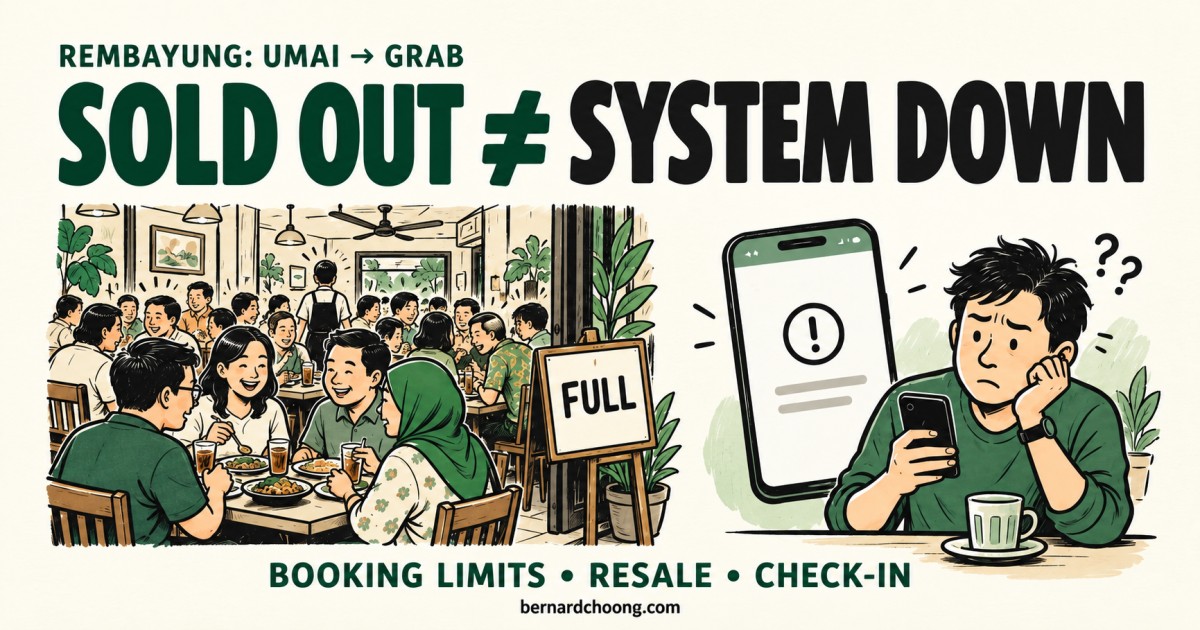
Rembayung has moved its bookings from UMAI to Grab. Some customers finally managed to reserve a table themselves. Others immediately asked how scalpers might still get through.
That is a fair question. But a useful system does not have to be impossible to abuse. We need to ask which problem a control addresses, how much harder it makes abuse, and how it is enforced.
First traffic overload, then competition for tables
When Rembayung opened reservations in January, the booking website struggled and Khairul Aming apologised. I wrote about queues, traffic and why auto-scaling alone might not be enough.
That was a problem of many people arriving at once. As reservations became scarce, another problem emerged: people obtaining slots to resell them.
A server can stay online while ordinary customers still struggle to get a table. Availability and fair allocation are different problems.
What changed with Grab?
In his announcement on 2 November 2026, Khairul Aming set out these rules:
- Each verified Grab user can make one booking every two weeks.
- Bookings cannot be transferred.
- Customers must bring the phone used to book and open the Grab application before entering.
- Screenshots are not accepted.
The important change is in these rules, rather than the logo alone.
Booking limits and door checks do different jobs
The two-week limit restricts how often one verified account can obtain a reservation. One account is no longer enough to collect a large number of bookings.
However, a verified account does not establish that one person cannot use additional accounts. The full verification process for these bookings has not been disclosed here.
Non-transferable bookings and application checks at the door try to connect a reservation to the person attending. Reselling becomes more complicated than forwarding a screenshot.
Those rules depend on restaurant staff enforcing them. The operation at the entrance is part of the system too.
Does this make Grab better than UMAI?
Some customers reported a smoother early experience, including people who previously failed to obtain a reservation. That is useful feedback, but it is not a comprehensive platform benchmark.
UMAI also offers reservation, table and queue management. A provider change does not prove those capabilities were absent, nor does it reveal Rembayung's previous configuration.
We can compare reported experiences and announced rules. We cannot invent the implementation details behind either service.
A possible loophole is not proof that every control is pointless
People have suggested that a scalper could hand over an account login. Other posts discuss charging to accompany a customer to the restaurant.
These scenarios deserve examination. They do not, by themselves, prove that someone has successfully bypassed check-in. The next question is how verification and admission handle them.
No single control prevents every form of abuse. A control can still help by making resale harder and reducing opportunities for it.
Sold out does not mean the website crashed
One customer can book easily while another opens the application after every slot has gone. Both experiences can occur while the system is functioning normally.
A smoother application does not add tables, chairs or kitchen capacity. Sold-out slots do not automatically prove a technical failure or that scalpers obtained everything.
Technical availability, physical capacity and reservation abuse need separate diagnoses.
What should we measure next?
The direction makes sense: limit repeat bookings, make transfers harder and check the application on arrival.
Now look at outcomes. Can more ordinary customers book for themselves? Is resale becoming harder? Does admission run smoothly?
Credit to Khairul Aming and the team for continuing to improve. The earlier question was how to keep the system working when everyone arrived together. The next is how to ensure the person holding the reservation actually comes to eat.
Sources
- My original ten-part Threads post
- Khairul Aming's Grab booking announcement
- September system-transition announcement
- My January Rembayung booking post
- UMAI restaurant-management products
- An early customer booking report
This analysis reflects announcements and early experiences available on 2 November 2026. It is not a backend audit, security test or proof that scalping has been eliminated.