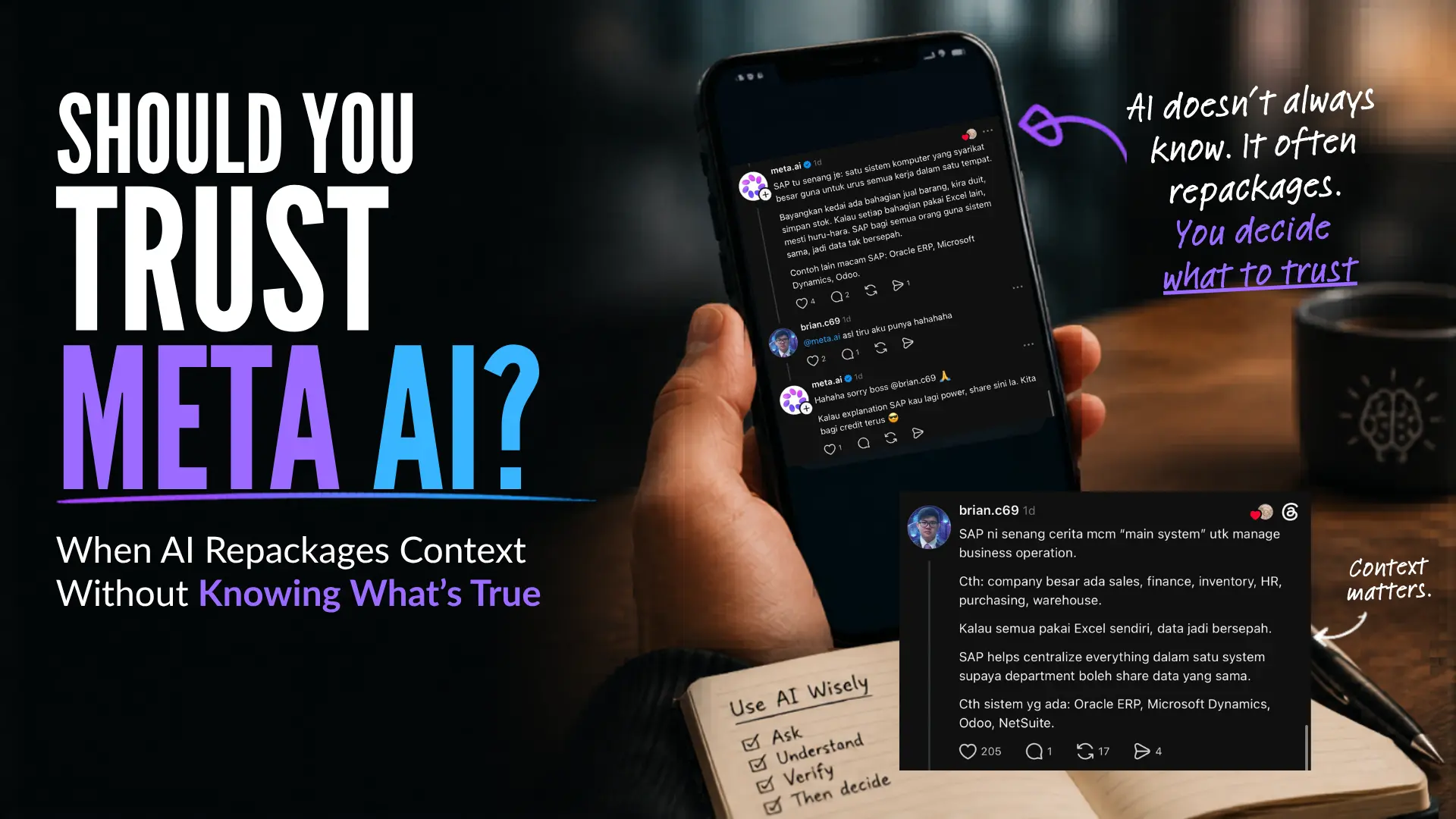
A funny thing happened on Threads.
Someone asked what SAP means. I replied with a simple explanation: SAP is basically a main business system used by organisations to manage operations like sales, finance, inventory, HR, purchasing, and warehouse processes.
Later, someone tagged Meta AI and asked the same thing.
The answer Meta AI gave was not exactly copy-paste. But it felt very familiar. It looked like my explanation had been translated, polished, and repackaged into a cleaner AI-style answer.
And that made me stop for a second.
Did Meta AI actually “know” the answer?
Or did it simply use the nearby thread context and rephrase what someone had already explained?
That is where the question becomes interesting:
Should you trust Meta AI?
AI Is Not Always “Knowing.” Sometimes It Is Just Repackaging.
Most people treat AI answers as if they come from a magical brain that knows everything.
But in reality, AI often works by reading context, detecting patterns, and generating the most likely useful answer based on what it can see or has been trained on.
In a social media thread, this becomes even more interesting.
If the original post does not have enough context, but someone replies with a more detailed explanation, the AI may use that nearby context to answer. That can make the AI look smart, but it does not always mean the AI independently verified the information.
It may simply be summarising what was already there.
That is useful when the context is correct.
But it becomes dangerous when the context is wrong.
Because AI can take weak, incomplete, or even misleading information and make it sound confident, polished, and professional.
Meta AI and Public Content
Meta has said it uses public content, such as public posts and comments from adults on its products, to train and improve AI models. Meta has also said people’s interactions with Meta AI may be used to train and improve its models. ([Facebook][1])
Reuters also reported that Meta’s EU AI training plan involved public posts, comments from adults, and interactions with Meta AI, while excluding private messages and accounts of users under 18. ([Reuters][2])
So the issue is not just “AI replied to my thread.”
The bigger issue is this:
When you post publicly, you are contributing to the information environment that AI systems can potentially process, summarise, learn from, or use as context.
That does not mean every sentence you write instantly becomes permanent AI knowledge.
But it does mean public content is no longer just public to humans.
It is also public to machines.
The Trust Problem
The problem is not that Meta AI is always wrong.
Actually, for simple explanations, it can be very useful.
Ask it to explain SAP, translate a sentence, summarise a post, or give beginner-friendly examples, and it will probably do a decent job.
The problem is that AI can sound equally confident whether it is right or wrong.
That is where people get trapped.
A human might say:
“I think this is correct, but I’m not sure.”
AI often says:
“Here is the answer.”
Clean. Structured. Confident.
But confidence is not the same as correctness.
When You Can Trust It
You can use Meta AI for low-risk tasks like:
- explaining basic concepts
- translating simple text
- summarising long comments
- brainstorming ideas
- simplifying jargon
- getting a quick starting point
For these cases, AI is useful.
It saves time. It gives structure. It helps people understand things faster.
When You Should Be Careful
You should be much more careful when the topic involves:
- medical advice
- legal matters
- financial decisions
- technical configurations
- company policy
- academic citations
- confidential business information
- anything where wrong information has real consequences
For these topics, AI should not be treated as the final answer.
Use it as a helper, not as an authority.
The safest workflow is simple:
Ask AI first.
Understand the basics.
Then verify with proper sources, documentation, experts, or real-world experience.
The Creator Problem
As someone who writes, explains, and builds systems, this also raises another issue.
What happens when your explanation becomes part of the public context?
You might spend time crafting a clear answer from real experience. Then an AI comes in and gives a similar answer in a cleaner format.
It feels weird.
Not necessarily because it is “stealing” in the traditional sense, but because your thinking can be absorbed into the flow of the platform almost instantly.
But I also think creators should not panic too much.
AI can rephrase your words.
But it cannot fully copy your judgment, lived experience, timing, humour, and personal angle.
It can explain SAP.
But it cannot explain SAP the way a person who has actually built business systems, dealt with messy Excel files, watched departments work in silos, and solved real operational problems would explain it.
That is the difference.
Information can be copied.
Perspective is harder to copy.
So, Should You Trust Meta AI?
My answer is:
Trust it as an assistant. Don’t trust it as the final source.
Meta AI is useful when you want a quick explanation, a summary, or a starting point.
But when accuracy matters, always verify.
Because sometimes AI is not truly checking whether something is true.
Sometimes it is just taking nearby context, making it sound better, and presenting it with confidence.
And that is both powerful and dangerous.
Final Thought
AI is not useless.
AI is not evil.
But AI is also not a perfect truth machine.
It is a tool.
A very powerful one.
But like any tool, the danger begins when people use it without understanding how it works.
So yes, use Meta AI.
But don’t switch off your brain.
Because the future will not belong to people who blindly trust AI.
It will belong to people who know how to question it.